Tuesday, February 7, 2012

Frugal February #7: What Do I Do With a Chicken?

I was actually asked that once: "What do I do with a chicken?"  The mom of one of DS2's friends was the one doing the asking.  Her son had recently volunteered to help us with butchering that year's flock of meat birds, and in gratitude for his assistance, at the end of 3 hours of butchering I had sent him home with a genuine local pasture raised chicken.  Three and half pounds, whole.

His mother is a friend of mine, but one of those friends that isn't your bestie, is not your closest friend who is so like you that you know each other's thoughts.  She's one of my many mom friends--our kids are friends, and so we too are friends.  She knew what to do with chicken legs, or chicken breasts from the store, but apparently, even though she is about five years older than I am, she had never cooked a chicken before that didn't come pre-cut into serving size pieces.  She really wanted to use that awesomely delicious and nutritious chicken her son had worked for, but didn't have a clue how to.

  
You may not know this, but whole chicken is the cheapest way to buy it at the store.  Cutting it up adds cost.  Last week, when I was at the store, I peeked at chicken prices to see what I'm missing by raising my own:  a whole chicken, uncut was 89 cents a pound (store brand, name brand was more).  A whole chicken, cut as I'm about to show you, was $1.19 a pound (again, store brand).  So, for a 3 pound chicken, you are paying almost a dollar more to have it cut.

Maybe paying an extra dollar for that doesn't bother you.  But let's put it into perspective:
  • Cutting a chicken is not hard. 
  • Cutting a chicken is something anyone can learn.
  • Cutting a chicken is not time consuming. Once you do it a few times, you can whip it out in about 5 minutes. 
  • There are 12 5-minute increments in one hour. 
 So, if you're paying somebody else $1 (for sake of easy math) to save you 5 minutes of cutting a chicken, that works out to an hourly rate of $12.  Sound a little more outrageous now?  I know alot of teens (and older people too) who would love to make $12 an hour doing simple tasks.

So, if you don't all ready know how to cut your whole chicken into useable pieces, let me teach you.

Take your whole chicken.  If it's from the store, rinse it well, inside and out.  If it's not from the store, and you freshly butchered it yourself, you should do this too.  If it's from your freezer, and you raised and butchered it yourself, hopefully you rinsed it before packaging and freezing.

1.  Put your chicken on a cutting board. 

 2.  With a sharp knife, make a slit in the skin where the thigh and rib area of the chicken meet.   


3. Grabbing the drumsticks (legs), one in each hand, firmly press down, pushing the legs backward.  


 Turn the chicken upside down if necessary.  You should hear the hip joints pop.  Once that happens, you can easily cut the thighs away from the body .


4.If you want to separate the drumsticks from the thighs, you can now make a slit in the skin where they meet, and push them away from each other.  You should hear the joint separate, just like the hip joint did.  Cut them apart now. 


5.  Use the same technique to remove the wings from the body.


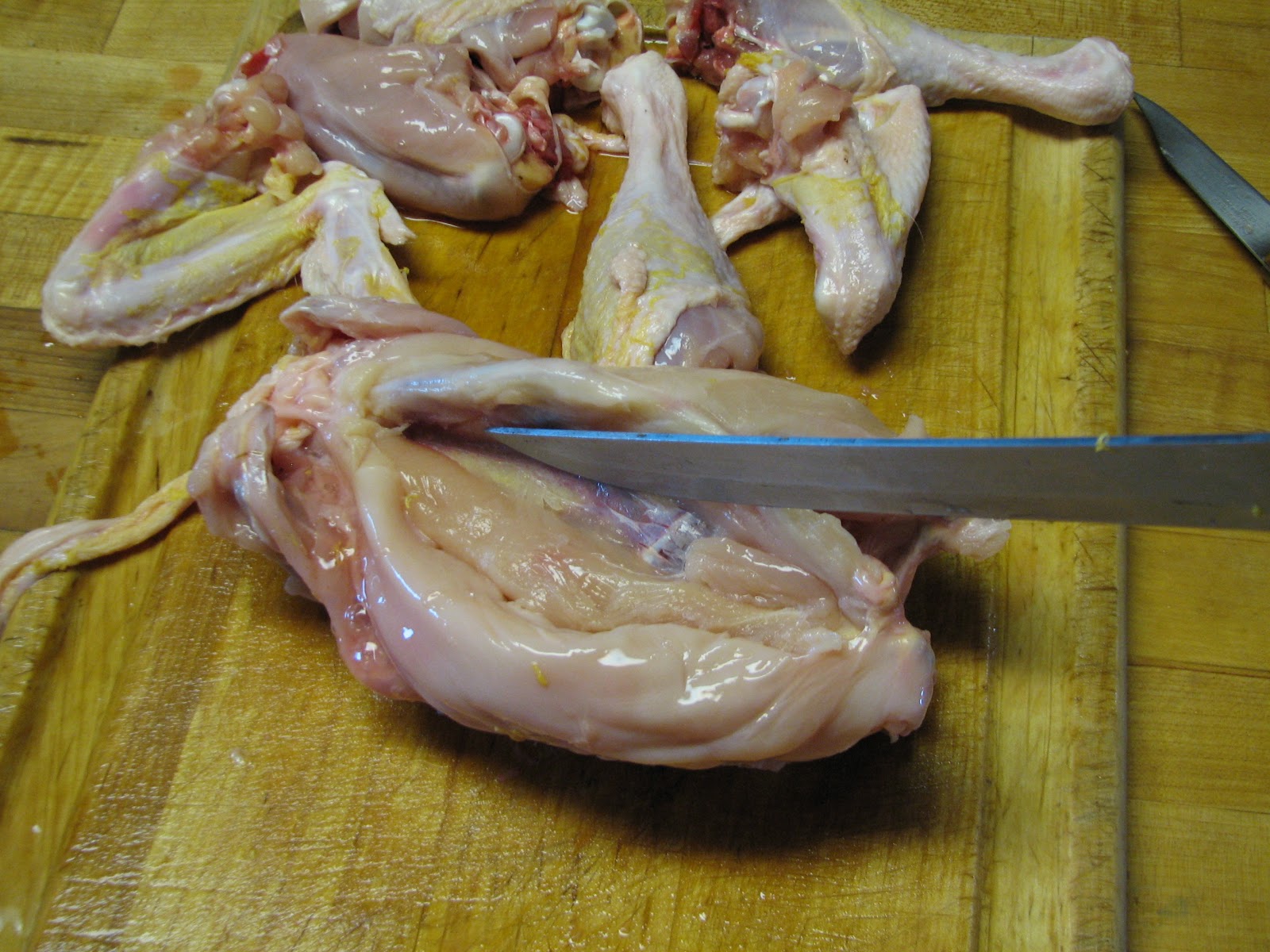
6.  I prefer boneless skinless breasts, so that is what I will demonstrate.  You can also have bone-in breasts, just cut the breastbone (keel) down the middle, and don't separate the meat from the ribs.  For boneless breasts, find where the meat attaches to the keel, and carefully cut the meat away from the bone.  Gently pull the breast toward you as you slide the knife between the ribcage and the meat.  Cut away at the bottom, and you have a boneless breast! 


For the back, you can cut through the spinal column, or just leave it attached to the carcass and use the whole thing for soup.  I prefer to do it that way, using the meat on the back in the soup.

carcass: keel bone, ribs, with back still attached


Ta Da!  You now have a chicken, in pieces, just like you can pay more for to buy pre-cut at the store.  It is now ready for any recipe you want to use it in. (I'd like to say, looking at these pictures of such a scrawny chicken, that this one was the runt of the bunch, only a 2.5 pounder.  Usually the pieces would be a bit bigger, and the whole thing more rounded.  Not all homegrown chickens look this puny.)


Here's one of our favorite recipes for a cut-up chicken:

Oven Fried Chicken
1 3 to 3.5 pound chicken, cut into pieces
1/4 cup shortening
1/4 cup butter
1/2 cup flour
1 tsp salt
1 tsp paprika
1/4 tsp pepper
1/2 tsp rosemary

Heat oven to 425 degrees.  While oven is heating, melt shortening and butter in a 13" x 9" x 2" baking dish.

Mix flour, salt, paprika, pepper and rosemary.  Pour into a gallon sized ziploc baggie (or you can use a brown paper lunch sack).  Place chicken pieces into bag, seal, and shake to coat chicken thoroughly with seasonings.

Place chicken skin-side down in melted butter/shortening mixture in baking dish.  Do not cover.  Put in oven on middle rack, and cook for 30 minutes.  Turn chicken over, and cook 25- 30 more minutes.


We like to serve this with mashed potatoes and corn or butternut squash.

Monday, February 6, 2012

Frugal February #6: Join the Library!

Are you a member of your local library?  If so, great!  You all ready have access to one of the places that make living much more frugal.  If you aren't all ready using your library, you should be.

My local library is free to join and use.  That's because a portion of our property taxes go towards funding the library.  But, I've lived in places where that wasn't so, where the library charged it's members an annual fee.  Even if your library isn't free, you still should join.  Membership fees are usually very low, and pay for themselves in no time with the savings you'll get from borrowing books and materials from the library instead of having to buy them in order to read/use them.

Libraries aren't just about recreational reading (fiction books) or educational reading/research (non-fiction books) any more.  Libraries also offer:
  • computer usage with internet access and printers
  • DVD 'rentals' (free at my library, unless you return it late, in which case it's $1 per day late fee)
  • music CDs
  • magazines and current newspapers (magazines can be checked out, newspapers have to be read in the library)
  • book clubs
  • children's summer reading programs
  • fun and educational activities for adults
  • books containing the local residential building codes (these came in sooooo handy when we were building the house at this little place here ourselves)

Think about how many books you read in a year (most of us at this little place here are voracious readers).  If you could read every book this year for free, how much money would you save versus having to buy each book in order to read it?

What about every movie you watch on DVD?  Every new release that would cost you $20 at the store, you could view for free by borrowing it from the library. Or even that monthly DVD rental program you're in--you wouldn't need it anymore, because the library doesn't just have movies on DVD, it also has TV series on DVD.  How much money would that save you?

How many music CDs could you listen to before deciding if you liked them enough to purchase?  How many could you listen to, decide you only liked one or two songs from it, and then purchase online just those couple of songs for your ipod or mp3?

How much money could you save by not subscribing to every magazine you were slightly interested in?  How many of those you currently own do you read all the way through?  Read more than once?  Save and have room in your home to store?  You could borrow them from your library, read the articles you were interested in, maybe photocopy the few articles you wanted to be able to refer to at a later date, and then return the magazine to the library, without having to worry about where to keep stacks of magazine back issues in your home.

This is a technique I do with cookbooks.  I have a collection of old faithful cookbooks at home, the newest one acquired five years ago.  Because since then, I've been borrowing cookbooks from the library, copying the few recipes I wanted to have, and returning the cookbook.  It's  a whole lot easier to store a few sheets of recipes in a folder in my kitchen that it is to store dozens and dozens of cookbooks that I'll only use a few recipes from.

For books that I borrow from the library, absolutely love and want to have on hand regularly, I look online for used editions, and only when I find one in good shape for a good price, do I buy it.  No impulse shopping at the book store where I'd have to pay full price.  Nope, a free preview courtesy of the library, then smart, frugal shopping.

Use your library.  It's a wonderful resource.  Your taxes may all ready be paying for it anyway.  Why spend more money to buy books, magazines, or movies you'll only view once?

Frugal February #5: Take Care of What You've Got

Ok, so we know what we've got (FF#3), we're using what we've got (FF#4), and now we need to make sure we take care of what we've got.

Cars: keep them maintained.  Know how to check the air pressure in the tires, as well as the wear on the treads.  Having proper air pressure can keep you from driving on a too-low tire and ruining the sidewalls.  It also can have an affect on your gas mileage ($$$).  Noting the wear pattern on your tires can indicate needing to rotate them, so they wear evenly and last longer, or it can alert you to the need for an alignment or time to start looking for a good deal on a new set of tires!  Also, know how to check oil and coolant levels, and do this regularly.  Much easier to check and top off when needed than to replace an engine.  Much cheaper, too.  Don't forget the inside of your car--dirt and grit on the seats and floor of your car can wear out the upholstery and carpeting faster, creating holes in either one.  Not good for resale value!  If you've got a shop vac at home, make a monthly date with yourself to vacuum out the inside of your car on a Saturday morning.  While you're at it, wipe off the dash, the console, the windshield, the back and side windows.  Check those fluid levels, and how are your tires looking?  Even if you don't have a shop vac at home, you can still make a monthly date, drive to the nearest do-it-yourself car wash and use their vacuum.  Wash that car while you're at it.  In warm weather months, you can wash it at home with a hose and a bucket of sudsy water (dish soap is great for this--gentle on the paint, yet capable of cutting grease).

Tools:  These need maintaining too.  Don't let the ones with moving parts get gummed up with grease and dust or sawdust.  Get a nice stiff whisk broom and clean them off after each use.  If they need lubing before putting away, do it.  A few minutes of care extends the life of a tool immeasurably.  Don't just leave them setting wherever you were using them.  Put them away!  What's better for a hammer or a pair of pliers--to leave it on the back porch overnight (and then it rains!) because the big game was starting in a minute, or to take that minute to put them inside the garage?  Yard work tools, like shovels and rakes, deserve the same good treatment.  Garden tillers, lawnmowers and tractors need oil changes just like cars do.  Spring, before first use, is a good time to do this.

Your house:  This one is really, really expensive to replace.  So take good care of it.  Get plumbing leaks fixed when they start, not months or years later when that little drip has rotted out the bathroom floor or allowed a colony of nasty mold to grow inside the wall.  Even if it's just a leaky faucet, it's still money dripping down the drain if you have to pay a water bill.  Or if your well pump has to run more often.  Speaking of floors, a daily sweep (for wood, tile or vinyl) or vacuum (for carpets) keeps grit and grime from wearing down your floor coverings, extending their lives.It doesn't take long to blast through a room and clean the floor.  Broken window?  Get it fixed asap.  It doesn't just let in cold air in the winter, running up your heat bill, it can also let moisture in during warmer times.  You don't even want to ignore a leaky roof or missing shingles.  Get it taken care of while it's still a small (and cheap) task. Little problems have a way of compounding, making them more expensive to fix in the long run. 

Sports equipment:  Not only costly to replace, it can be down right dangerous if they break while in use.  Make sure to check them before using, and to put them away clean afterward.  This goes for your leather goods too, you horse riders out there!  My saddle and bridle get a quick clean with Murphy's Oil Soap and warm water after each ride.  Keeping your leather in good shape (and moisturized) keeps it supple, making it less prone to cracking and breaking while you're on your horse's back.  Not only that, the few minutes you spend cleaning it after each use allows you to inspect it, so that if it does look like it's about to give, you can get it fixed before that happens.  It also makes saddles and bridles usable for generations, like they should be (my 30 year old dressage saddle is still nice and buttery soft, compared to one half it's age that has been eaten up by dust and salty horse sweat).

Clothes:  Washing them is not enough.  Washing them properly is everything.  Read those care labels.  Sort your laundry, and wash it on the proper temperature and cycle.  Know whether or not it can handle the heat of a dryer.  If it can't, make sure you air dry either on a clothesline, or somewhere indoors like over a shower curtain rod or on a drying rack. Iron on the correct heat setting also.  Know how to do simple repairs, like sewing on a button, or mending a seam that is coming unstitched.  Why have to go buy a whole new shirt when all you need is a new button?  Buttons are cheap.  Buy a new one of those instead.  Or, better yet, when you have worn out clothes with buttons that are going to the rag bag or the trash can (hopefully the rag bag first!), snip those buttons off and save them for future replacements.

Food:  Take care of your food may sound like a strange thing to say.  But it needs proper care too.  When you bring it home from the grocery store, or in from the garden, the orchard, or the butcher, it needs to be stored in the right temperature and humidity.  Flour and sugar aren't any good if they get damp.  Neither is pasta.  Milk doesn't want to sit out on the counter for hours.  Potatoes don't like being left in the freezing cold garage.  This doesn't just apply to "new" food; it also goes for leftovers.  Clean up from that meal as soon as you are done eating it.  Get the milk jug put back into the fridge, don't forget it on the counter.  Take that leftover roast and decide how you are next going to use it, then package it that way  and get it into the refrigerator (ie, slice it for sandwiches, or shred while still warm to be used for BBQ beef for lunch the next day, and put in serving size containers you can grab and put into lunchboxes in the morning.)  Make sure the cracker container gets sealed  completely and back into the cupboard, so that the next time you have soup your crackers aren't stale.  If it's 80 degrees inside the house, don't leave the butter out to melt into a puddle, put it in the fridge too.

A few minutes here and there that are spent in caring for what you have makes what you have last longer.  Lasting longer saves you money.  So take care of what you've got.

Friday, February 3, 2012

Frugal February #4: Use What You've Got

Directly related to knowing what you own, is using what you own.  This one should be a no-brainer.  I mean, why own it if you're not going to make use of it? 

This goes for a lot of categories of items.  Clothes, furniture, appliances, toys, sports equipment, tools, vehicles, even your home and your yard!

Clothes:  obviously, unless you are a nudist who lives in a warm climate, you're going to use clothes.  But let's be honest now, how many pieces of clothing in your closet or dresser haven't you worn in at least a year?  Why are those particular pieces still in there?  Will you ever wear it again?  If not, and it's in very good shape, try selling it.  Make a little cash off of it.  If you're not going to wear it, and it's in so-so shape, is there somewhere you could donate it to?  Think outside the box.  Maybe a preschool would take it for a bin of "playing dress up" clothes.  Or, maybe the local high school or community drama/theater group would like it for their costume closet.  Or, maybe you know someone who would love to have it as a hand-me-down.  Or, perhaps as clothes it's not all that use able, but as fabric it is.  Maybe it could be used by someone who quilts or makes rag rugs. 

Now, for those clothes that you do want to keep, and do plan on wearing, make sure you do!  And if they are good quality and traditional colors/cuts, you can keep and wear them for years rather than purchasing identical new ones.  I have a black, straight skirt in my closet that I've been wearing for at least a decade.  It's not worn out yet, and it's still in style.  I also have a knit, brightly colored floral sundress that I wear.  I received it as a hand-me-down from my mother.  She bought it in 1993.  In 2011 I wore it to DS2's graduation, and got compliments on it.  Obviously not out of style yet.  How much money have I saved by keeping and using those two items through the years versus buying a new black skirt or a new floral sundress several times since first acquiring mine?

Furniture:  Maybe a little off the wall here, but use your furniture.  You paid money to get it, make sure you use it!  Be creative in the pieces you own before you go out and buy specialty pieces.  I have a 2-drawer file cabinet next to my bed.  It's a file cabinet. . .and it's also a night stand, holding a bedside lamp, my alarm clock, and whatever book I'm currently reading.  I could have gone out and bought a night stand, but I had this file cabinet that I outgrew (and was lucky enough to 'inherit' a 4-drawer one that fit in the same footprint in my study/office).  So now I can keep my non-financial files--my folders of quilt block instructions, lists of blocks for a future sampler quilt, handwritten notes on story ideas, etc--upstairs where I do my crafting and creating while at the same time not needing to spend money to get a 'table' to set my alarm clock on.

What do you have that is useful, but not being used at the moment?  What do you want that perhaps that item could double as?  DH's 'night stand' is an 18 gallon plastic tote that holds my scrap fabric.  Not as pretty as a wooden table, but it holds his alarm clock just as well (yes, we have two alarm clocks. . . long story.  I'll just say he's a heavy sleeper who can shut the alarm clock off without waking up or realizing he's doing it.  I got tired of being late. . .) 

Another furniture item I have that does double duty is my cedar chest.  A 16th birthday present from my grandfather, it originally belonged to his mother, my great-grandmother.  It sits in my living room, where it holds extra bedding and pillows for overnight guests who might need to sleep on the couch.  On top of it, I spread a decorative piece of fabric relevant to the current season, and display framed family pictures.  One piece of furniture, two uses.

Appliances:  Let's keep it short.  Appliances, especially small appliances, are like clothes.  How many do you have?  How many do you use?  How many do you really need?  Do you have any that you could sell?  How many will suit more than one purpose, and therefore keep you from buying more?  I have an antique waffle iron (I assume a 1960-something chrome appliance is now an antique, lol) with removable/reversible plates that are flat on the back side.  It makes waffles, or pressed sandwiches.  No need for a sandwich iron/panini maker. 

A blender is the original whipped drink maker.  No need to buy one of those little wand things that make your drink frothy.  A blender is also great for grinding nuts, making baby food, or powdering dried cayenne peppers from the garden into some really kicking cayenne powder.  Really kicking.  If you do this, do not breathe in the vicinity of the blender after removing the lid.  And whatever you do, don't stick your finger in the powder, then lick it.  You will blister your mouth (DD1 will confirm this).  Use about 1/2 the amount of homemade cayenne that any recipe calls for.

Toys and Sports Equipment:  Kids are really innovative if given the opportunity to be.  They don't need every toy under the sun.  Probably they will have some tried and true old-faithful favorites, and ignore the rest.  So, you know what to do with the rest!  Sell!  Donate!

Sports Equipment is the same.  If they don't use it and won't in the foreseeable future--foreseeable being from now until they leave home for college--sell it or donate it.  If you aren't going to use it, there's no sense taking up space with it.  There's also no sense in it moldering in a garage, basement, or shed for decades when it has resale value now.

Tools:  many tools have several uses.  Knowing what can be used for what, and what it will also do in a pinch, will, at times, keep you from having to purchase more tools.  A utility knife will not only cut a sheet of drywall to size, it will also cut the twine on a bale of hay, cut open a bag of potatoes that the darn pull-string got knotted on, and reduce a broken-beyond-repair couch into small enough pieces your trash man will unknowingly haul it away without charging you extra.  A framing hammer will pound a nail just as well for you as a finishing hammer, if you have the right touch and good enough aim. 

Vehicles:  They're expensive to buy, expensive to insure, and can be expensive to maintain.  If you've got one, you sure better use it!  No sense having one sitting around that gets used once in a while.  Not in a day and age where you can rent a truck if you need to haul stuff.  I'm trying to figure out a way, once the kids are all gone from home, that I can convince DH to be a one-vehicle family.  I mean, if the furthest I have to go to get to 'work' in a day is 1.5 miles, I think I can handle that without driving.  Once upon a time, a car was a luxury and it was a rare family that had more than one.  Unless you and your spouse both work at the same time in very opposite and distant directions and no public transportation or alternate transportation is available, could you possibly get along with just one vehicle?

Your home and yard:  How much time do you spend in them?  How much recreational time do you spend elsewhere?  What do you pay per month, and in property taxes to own this house and yard?  Do you use it enough to justify that expense?  Mine get used a lot.  My kids have never had a birthday party at a place we had to pay to use.  It was senseless, since we all ready had a house and a yard at our disposal.  When one house we lived in was too tiny to handle an indoor fall birthday party of eight rambunctious six-year olds, we cleaned out the garage. The kids thought it was the coolest thing.  The backyard hosted a 'sprinkler' birthday party in July.  The kids had a blast donning bathing suits and running through the sprinkler, then beating on a pinata hung in a nearby tree.  None of them ever said to me "This party sucks, you should have had it at Chuck E Cheese."  We've hosted scavenger hunts, and weenie roasts for middle schoolers and teens, all in the yard.  We have, so far, had two graduation open houses at our home, each of which had over 100 guests.  No hall was rented to handle the crowd; we cleaned out the garage, borrowed tables and chairs from our church, set up volleyball in the front yard and croquet and bocce in the back yard, and lit off a bonfire after dark.  We're planning a repeat this June when DD1 graduates.


Use What You Have.  Otherwise, why have it?  If you don't use it, you wasted money in the acquiring of it, and are wasting more in the storage and maintenance of it.

Frugal February #3: Know What You've Got

Have you ever had the experience of looking for an object in your home and coming across something useful that you didn't even know you had?

How about knowing you owned something, but not being able to find it when you needed it?

How about knowing you owned something, and needing it right now, but not being able to find it and having to go out and buy a second one so you can use it right now?

Know what you've got.  It's a way to save money.  If you know what you've got, and where to find it, you won't have to run out and purchase a replacement when you can't find something you need to have today.  Likewise, you won't accidentally purchase a second of something you all ready own and definitely don't need two of.

Being organized is a frugal trait.  It saves you time looking for things.  It saves you money from purchasing more than necessary.  It also helps you to prioritize what you need to purchase.  I don't own a black belt for dressing up, but I do own an 'everyday' brown one.  If all my blouses and sweaters are worn to cover the waistband and belt loops of my pants and skirts--thankfully tucked-in shirts aren't the only style currently--I don't really need to go spend money on a black belt any time soon.  I can use the brown one, and wait until I find a good deal on a black one before I purchase it.  In the meantime, I can use what a new black belt, not on sale, would cost towards something else much more urgent.  Like maybe gas in the car. Or an electric bill that was larger than expected (or budgeted)!

So that's an over simplification, but I think you get the point.  I know someone who has about a dozen white cotton ribbed turtleneck sweaters, most of which are all the same size and have never been worn.  She bought a few, put them away, forgot where she put them, couldn't find them, and when she needed one for an occasion, she purchased a couple more (so she had a replacement in case the one got stained).  The next year, she forgot she'd purchased replacements, still hadn't found the first set, and mail ordered a few more. 

What unnecessary expense!

Know what you have, and where to locate it, and you won't needlessly spend money.  Know what you have, and how to maybe make it substitute for something similar, and you can wait until you find a real bargain on that similar item--if you even think you still need to purchase it.

Thursday, February 2, 2012

Frugal February #2: Never Pay Someone Else To Do What You Can Do Yourself

I guess you could say that's been DH and my motto for a long, long time: Never pay someone else to do what you can do yourself.  It has saved us thousands of dollars over the years, perhaps even edging towards a six-figure savings by now. 

(I say six-figures because, with DH's background in construction--he grew up helping his dad in the family business--we remodeled one house ourselves without hiring a builder, and did about 85% of the construction on the one at this little place here ourselves.  Not having to hire a contractor: priceless!)

Think about all the possible services you currently pay for.  Which of those could you save money on by doing them yourself? 

I'll give you some examples from the things we do at this little place here.


Changing the oil in the car: simple, and if you know where to dispose of the oil, it's an easy way to save some money.  When our boys got old enough, DH taught them to do this chore so he wouldn't have to.  Now that both sons are out of the home, I keep teasing the daughters that it's their turn to learn.  I know how to do it, I've changed oil myself more than a time or two, but it's something the girls should learn to do too.  It really doesn't take much time, less than half an hour from start to totally cleaned up and put away.  Think about it: if those quick-change oil places can get you in and out in 15 minutes, it's not a horribly time consuming task.

Mowing the lawn.  Unless you are working 80 hours a week, or have a physical disability that keeps you from labor like this, there is no good reason (to a frugal person) to hire someone else to cut your grass.  It's another simple thing that just takes a little effort and time.  Anybody over 40, think back to when you were growing up.  Mowing the lawn was a chore that traditionally fell to the kids.  How complicated can it be then?  Get out there, work up a little sweat, and get some exercise while cutting the grass!

Cooking.  Forget the health benefits of cooking your own food.  Let's just talk about the money savings.  Pizza from scratch to feed six: less than $10 (and that's 'with everything').  Pizza take-out to feed six: $20+, depending on how many toppings you get.  Frozen pizza to feed six: at least $10, and that's the cardboard nasty kind.

Housekeeping.  Ladies, if you are stay-at-home moms/wives and you're looking for ways to save money, there is absolutely no excuse for hiring someone else to clean your house.  Even if you work full time, and your spouse works full time, your house is sitting empty most of the week and should be able to be put back into spic and span shape on the weekend.  And if you have kids over the age of about ten, you should be putting them to work on housekeeping chores.  It's training for their adult lives, so they won't have to pay someone else to do what they could do for themselves either.

Minor auto and home repairs.  These are things that once upon a time everyone knew how to do.  They don't require a college degree or a license from some government entity.  Check out those Time Life books, LOL.  I have a son who dropped and replaced two transmissions before he turned 19, and another who just replaced an intake manifold and seals, air filter, and spark plugs on his car at 18.  When I was 25, we embarked on a major remodel of our house, of which we did not hire any part done; DH and I did it all ourselves with the occasional assistance of friends and relatives--can you say a big pot of home cooked food and a case of beer?  Much, much cheaper (and more fun!) than hiring contractors. We went on, when I was 30, to build from scratch the home we live in at this little place here.  Even DD2, who was only 5 years old at the time, hammered nails and helped construct this house.

Deer processing.  Okay, so this might be a stretch for most of you.  But, if you're interested in homesteading, I'm taking a guess that you might also be a hunter or someday become a hunter. Hunters, it's not hard to process a deer.  If you know someone who does this, ask them if you might assist them next fall during deer season.  I guarantee after helping with just one deer, you'll know enough to process your own.  Jeez, guys, if you can field dress it, you've all ready done the nastiest part.  Processing it from there is not gross, and it's certainly not complicated.  My kids have grown up assisting with butchering out the deer we harvest.  It's a great lesson in biology and anatomy for them (not to mention a useful skill they could make money on in the future).

Hair cuts.  This is not hard.  If you and/or your family members all ready wear your hair in a pretty basic style, you can learn to cut it.  I have absolutely no official or professional training in cosmetology, yet I've been cutting DH's hair (which needs to look professional for his job) for over a decade and a half.  My sons had hair cuts not-by-Mom exactly twice in their lives prior to leaving home.  DS2 just paid for his first cut himself two months into college this past fall, and he told me he wasn't going to "pay $12 after a coupon" for a hair cut ever again.  While home on semester break he had me cut his hair, and plans to live with 'shaggy' hair from about mid-Feb until Spring Break when he can get home again for me to give him another hair cut!  Look up tutorials on YouTube or do an internet search.  Get a book.  Seriously, you can do this.

Taxes:  Whoa!  Taxes?  If you are filing an EZ form, you can definitely do this yourself.  Yes, it takes some time, but if you skip a few TV shows in an evening, you can pretty much have that EZ form wrapped up and sent off to the IRS so they can get you your refund.  And you'll never have to pay an accountant or tax preparer to do it.  You don't even have to buy the tax software.  We don't.  The IRS has everything online, and you can access all the forms and instructions for FREE!!  Even if you aren't filing the EZ form, you can learn to do your taxes.  DH  paid someone else to do his taxes exactly once.  Then he met me, who had two semesters of college-level accounting under her belt.  I was nineteen, and was determined I knew enough to not have to pay someone to prepare my tax forms for me (that was the main reason I chose to study accounting--so I could do my own books & taxes--because I sure never intended to spend 40 years as a professional bean counter).  As we progressed from EZ to regular 1040, and from there to multiple Schedules and other forms, all it took was a bit of studying on the IRS website to figure out how to fill in the 'new' and 'tougher' forms.  I don't even know how much it costs to have someone else file all our forms for taxes each year.  All I know is that money stays in my pocket because DH and I do our taxes ourselves.  The way I see it, accountants and tax preparers have to study the new regulations and changes to the tax code each year to keep current.  That's not an impossible task for me or you. Devote a Saturday afternoon to it.  Or an evening when there's nothing but crap on TV.  A handful of hours studying and reading up on tax stuff, and I'm good to go for another year.

Wednesday, February 1, 2012

Frugal February

Back at the beginning of January, I was cleaning horse stalls, and thinking of ways to reduce our expenses.  (Cleaning stalls is great thinking time. If world leaders cleaned stalls, most of the world's problems would probably be solved by now. LOL) 

January always seems like a time when people get interested in saving money--probably because they get their credit card statements from all that Christmas shopping--and are willing to try things they wouldn't normally consider.

It came to me, as I was sorting road apples from pine shavings, that perhaps I could share some of my penny pinching strategies.  Not only could I share some, I thought as I made a mental list of topics, maybe I could devote an entire month of posts to money saving tips.  So, I came up with a list of 29 blog posts--yay Leap Year!--and Frugal February was born.  Most likely not every reader will be able to incorporate every tip.  Some posts will only be applicable to those with children.  Others, to those that own the home they live in.  Others, to people who aren't restricted by homeowner association rules. Some won't apply if you don't have pets and/or livestock.  But I hope each tip will be helpful to someone.

This month, I'm going to do my best to post one new frugal tip each day.  Being a realist, I know weekends are usually tough for me to get online--something about sharing one computer between four of us at this little place here; most of my computer time is afternoons while DH is at work and our daughters are at school.  So, please excuse me if I have to post 2 or 3 on a Monday to make up for nothing new on Saturday and Sunday.

Without further ado, let us begin Frugal February with our first money saving tip:

No More Pan Spray!

This one is pretty easy, and will apply to anyone who doesn't buy tubs of margarine.  In other words, if you buy real butter in sticks, or margarine in sticks, rather than whipped spreadable form residing in a plastic container, this one will work for you!  If you currently do buy tubs, now might be a good time to switch to sticks. . .   ;0) 


I haven't used pan spray in. . .I don't know.  A decade, maybe more.  I know I've never had any at this little place here, and we moved to our homestead here in Sept. 2003. 

Instead of spraying your pans with an aerosol product from a can (we all know the major name brand one), save your butter or margarine wrappers.  I fold mine in half, and store them in the refrigerator in the back of my 'jelly box'--a small, shallow, plastic basket that holds our open jars of home made jelly & jam.

These wrappers work great for greasing pans.  If there isn't quite enough butter residue on the wrapper to grease the entire pan, just touch it lightly to your stick of butter (that is sitting on the counter in a butter dish so it will be soft and spreadable,  right?) then rub the wrapper over the surface you want greased. 

If it's a cake pan that you want to be able to remove the cake from, such as in making a layer cake, after you've rubbed the wrapper over the pan, put in a handful of flour and tilt the pan back and forth until the bottom and sides of the pan are coated in a light layer of flour.  Pour out any remaining flour before putting the cake batter into the pan.  This is the way Grandma did it before pan spray was commercially available, and guess what?  It still works in the new millennium!

For bread pans, use the wrapper to grease only the bottom if it's a batter bread such as banana bread, grease bottom and sides if it's a yeast bread.

For pizza pans, use your wrapper to grease pan then lightly sprinkle with cornmeal to keep the pizza crust from sticking.

On a related note, did you know that those paper muffin cup liners aren't necessary when you are baking muffins and cupcakes?  They're not, unless you want to add expense and be decorative.  You can grease the cups of your muffin pan with a butter wrapper, and your muffins and cupcakes will come right out.  Personally, I think using butter wrappers to grease the muffin pan instead of using paper liners has a double money saving feature:  1. you don't have to spend money on those fluted paper cups, and 2. you will get to eat all of the muffin or cupcake instead of just the 3/4 of it that didn't stick to the paper!

So, there's tip #1 for Frugal February.  I'm looking forward to sharing tip #2 with you tomorrow. . .